
Save our sea turtlesSave our sea turtles

The Turtles of Tobago

Tobago is home to three types of marine turtle, all of which are endangered. Two of them, the Leatherback and the Hawksbill have recently been moved to the critically endangered list, which means it is highly probable that we will lose them altogether. The only chance we have of preventing this is to continue to increase our conservation work.

Turtle Laws in Tobago

Trinidad and Tobago has signed the Convention on Trade in Endangered Species of Flora and Fauna (CITES). Accordingly, there is to be NO import or export of sea turtles and their products with any of the signatory countries. Persons caught with such products will face severe charges.

The Trinidad and Tobago Conservation of Wildlife Act, Chapter 67:01 addresses the protection and management of all wildlife and bans all hunting from 1st March to 30th September. This law is currently being revised and strengthened.

The "Protection of Turtle and Turtle Egg Regulations" under Section 4 of the local Fisheries Act of 1975 mandates that no person shall catch, kill or sell any turtle during the nesting season (1st March to 30th September). It further bans turtle hunting within the nearshore or reef throughout the rest of the year as well as making the possession and sale of turtle eggs illegal year-round.

Hawksbill Turtles

Eretmochelys Imbricata

Hawksbills can weigh up to two hundred pounds and generally measure up to two and a half feet long.

Their hard, elliptical shell is made up of overlapping amber plates streaked and mottled with brown, black, yellow and/or red.

Hawksbills are the most tropical of all sea turtles, preferring to live in the clear, relatively shallow water of coastal reefs, bays and lagoons.

Their hawk-like beak that inspires their name allows them to eat sponges, corals and other invertebrates, most of which are poisonous.

Hawksbill meat is considered toxic in some areas due to the nature of their diet. However, locally they are the preferred eating turtle.

Hawksbills are also prized for their beautiful shells from which a variety of ornamental craft items can be made.

Trading in turtle shells and turtle shell products has been banned internationally under CITES (The Convention on International Trade in Endangered Species of Wild Flora and Fauna).

Hawksbills are critically endangered worldwide and overhunting is their biggest threat.

Green Turtles

Chelonia Mydas a.k.a. Greenback

Green Turtles can weigh approximately three to four hundred pounds and measure about four feet in length.

They have a hard, oval shell which is usually olive brown with blotches or radiating streaks of subtle color.

They feed primarily on sea grass and algae. This gives their body fat the greenish color to which their name is attributed.

They inhabit warm, shallow waters where there is an abundance of sea grasses.

Green Turtles have been hunted for centuries for their meat and the gelatinous "calipee" that is made into soup. The turtle shell is also regarded as decorative.

Unfortunately, greens have been particularly hard hit be new diseases such as fibropappilomas virus and in some places as much as as 90% of the population is infected.

It is not known where exactly this disease comes from or if it can affect humans through consumption.

Greens are listed as endangered. They have been responsive to global conservation efforts, though local populations remain in a critical state due to overhunting.

Leatherback Turtles

Dermochelys Coriachia a.k.a. Battalie / Coffinback

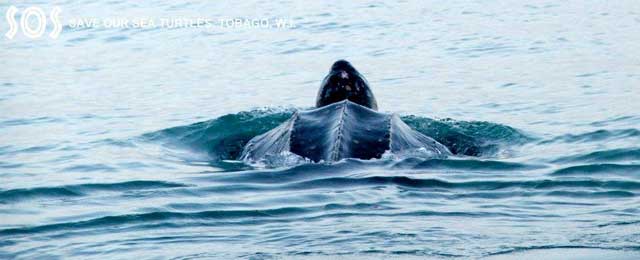
These are the largest and most endangered of the marine turtles, weighing up to 2000lbs and measuring up to 8' in length!

Leatherbacks have a rubbery, dark shell or carapace marked by seven narrow ridges that extend along the length of their back.

As adults, their diet consists solely of jellyfish and other related sea-organisms.

Their migratory routes take them as far north as Newfoundland and as far east as Africa, bringing them into local waters only during the mating and nesting season (April - September).

Due to their immense size, the Leatherback's only natural predators are sharks and man.

There are many places throuhout the Caribbean and latin America regions where Leatherbacks are regarded as inedible. Unfortunately, here in Tobago, Leatherbacks are still seen as a traditional food source and poaching during the closed season remians a huge threat to the species.

SOS History |SOS Projects |News |Get Involved |SOS Shop |Links |Contact Us

Conserving Tobago's turtles and their coastal and marine habitat through community based initiatives in education, research and eco-tourism.